Dick Vara’s Translation of origins of Greci
Dick Vara’s The Cugini Home Page Is no longer on the Internet. Dick was the first person to present Greci, Italy on the web. His sight was unique and it was great. When Dick died his sight stayed up until AOL deleted it along with many other family history sites.
I have wanted to try to bring back parts of his great site and I decided that the first part I will attempt to reconstruct is Dick’s translation of the following book:
Apputi Di Storia Cronologica Di Greci
By Sacerdote Gerado Conforti
Published in Napoli, 1920
Translated by Dick Vara -4-12-1997 John Mazzarella”
I wish to thank Lenny Vara for saving a hard copy from John’s website. I also wish to thank everyone else who is helping put together this site and everyone who will contribute to it in the future. Our objective is to ensure that this site remains permanent by securing sustainable funding for its ongoing operation and future development.
Anthony W Tozzi Jr. Aug. 25, 2025
Part 1 -ORIGIN OF GRECI
There are two areas in Albania that bear the name Greci; one of about six thousand inhabitants in central Albania, above Tirana, and another composed of a few houses in Alta Albania, High Albania, near the Triepsei tribe on the boundary between Albania and Montenegro. However, the name Greci has not been taken from the country of origin of the Albanese refugees in Italy because Greci already existed with this name when the refugees came to live there. Also, we see that while the two above mentioned areas are found in central and high Albania, the Albanese of Greci have a preference for lower Albania since they speak the Tosk dialect and not Gheg.
To understand the origin of the name Greci we must remember its first inhabitants.
History records that in the year 535, Giustiniano, Emperor of Constantinople, wanting to drive the Goths out of Italy, ordered the famous Belisario here, thus giving rise to the formation of many Greek colonies in our southern provinces to restrain and keep in check the conquered towns, and to inspire in the defeated people a spirit and love for the government of the East. Also he wanted to lay foundations as the great emperor in these distant lands and consolidate his rights of authority as a feudal lord.
We know also that the rule of the Greeks in Italy did not end in 568 as some suggest with the call of the Longobardi for part of Narsete. The Greeks maintained many of their colonies in southern Italy after that and would later give the baresi an opportunity to reconquer other land too. The baresi, seeing that many saracens from Africa based in Taranto made raids and incursions into Benevento and routed Prince Adalgisio that year, feared they would fall into the hands of the barbarians too. They summoned the Greek general Gregorio from Otranto , who quite willingly came to take charge.
The domain of the Prince of Benevento included the city of Bari, and after many years he looked to claim it. However he did not succeed. Later, Simplicio, general of Leone the Wise, Emperor of Constantinople, (mosse?) war against Orso, young brother of Ajone, and beseiged Benevento. The city surrendered after a brief resistance and fell under the rule of the Greeks. Such conquest however would be of brief duration. After only three years and ten months the Greeks were no longer found in this principality, and besides, had given back everything they possessed.
Many places of Calabria and of Puglia, like Conversano, Matera and other lands remained subject to the Greeks of the East. And those powerful people, for a much longer time, (piu’ che scemare?) went to battle reaching out and redeeming the masters of Ascoli Satriano in 950, and occupying the city of Bovino afterward. And in 969 when Ottone I, called “The Great”, came against them and surrounded and beseiged the occupied city (Bovino), he was unable to drive out the Greek garrison.
Therefore it is very probable, rather, almost certain that Greci had been built by the Greeks after 535, that is to say during the expedition that Giustiniano, Emperor of Constantinople, sent to southern Italy under the command of general Belisario (facendovi?) to establish many greek colonies, including the colony of Greci. And my conviction is strengthened also by the fact that in 1018 Boggiano (1), the catapano ( the greek governor) at the time of emperor Basilio, building the other Greek colony of Troja (formerly Ekla) in memory of the old Troja (diede?) to (this last?) along with the pre-existing Greek colony of Greci, in order to keep the town boundaries of the Greek colonies unified and compact. Boundaries for the two aforesaid were the Sannoro and Lavello rivers and the road that led from Lucera to Bovino. (2)
FOOTNOTES Part 1
(1)-Boggiano, in order to leave a record of himself in Italy, removed a part of Puglia near the principality of Benevento, and created a new province there, that is to say another Troja, and also Dragonara, Ferenzuala etc. And from then on this new province was named “Capitanata”.
(2)- The great religious schism of the East had not erupted yet and the Greeks who established themselves in this area (to which they gave the name) although (fossero) of the Greek rite, were catholic. However, the other Greeks that later came to live in the principality of Benevento, Puglia and Calabria, were almost all of Greek schism rite. Historians of the time record that in the 9th century Emperor Leone the Sensible, relying only on the patriarch of Constantinople and without the consent of the Pope in Rome, established in all these provinces, several Byzantine convents, along with six dioseses with Greek rite, among which were Morcone, Civitate and Rossano.
These dioceses of the Greek rite survived in the said provinces until the 13th century. Although the Greeks removed the Longobardi and the control they had in Italy, they never were able to remove them completely.
These people, with or without their respective bishops, continued to live as Greeks with their habits and rites, and also with their barbarians. And the insolence of all these Greeks was a sign that they expected they could only be excommunicated by the patriarch of Constantinople. For them the authority of the Greek patriarch extended as far as imperial authority.
Later, however, Nilo Doxopater, impassioned Byzantine writer of the 12th century, would confess that in Lombardy and in Puglia, the Greek patriarch had the maritime cities, but all the other cities belonged to the holy see of the pope of Rome, whose authority was recognized by the Eastern emperor, Basilio.
In the meantime, to suppress the insolence of the Greeks that were firmly established in Italy, pope Giovanni spoke up, which is the privilege of the confirmation. Summoning the excommunication, he retorted: “sive graecus sit sive quicumque alter homo”. And following the example of the pope of Rome, and the illustrious presuli of the metropolis of Benevento, cardinal Savelli and Cardinal Orsini, who did not fail to sanction of the providence, he acted to restrain the Greek haughtiness.
On 14 April 1567 Cardinal Savelli called together a provincial synod principally “pro reformatione graecorum, eorumque erroribus tollendis” placing all the Greeks living in his ecclesiastic province under his jurisdiction and that of the other bishops. In Capo? IV, against the same Greeks, who demanded that their priests had to be ordained by the patriarch of Constantinople, sanctioned that the said priests “nonnisi a propriis ordinariis” [already submitted to the obedience of the Roman pope] “statu ritu ac tempore ordinentur”.
And cardinal Orsini, who afterwards was pope with the name Benedetto XIII, in the provincial council that he celebrated on the 6, 13 and 16 April 1693, (occupando anche lui dei?) Greeks, in Chapter V, of the title XLVIII, confirming (quanto dall’altro suo?) predecessor had been established, (sanciva?) this new canon, that closed forever the bad (epresse?) Byzantine claims of the Greeks, “Graeci, episcopo latino subiecti, nonnisi ab eo ad ordines suscipiendos dimissi feurint, in poenas et censuras, ut latini subditi, incurrunt..”.
“Progressu temporis” therefore the Greek rite in the southern provinces of Italy, “sensim sine sensu”, went vanishing interamente?
Translation Draft by Dick Vara – 4/17/97
Part 2 - DESTRUCTION BY THE SARACENS
The destruction of the town of Greci recalls one of the most unfortunate periods that were to befall the southern provinces of Italy, when the saracens from Africa passed among us spreading desolation and sorrow, plundering all our riches and destroying our freedom. Here we show briefly the black chronicle of their deeds and how they came, as told by historians of the time.
About the year 848, Emperor Ludovico XI, son of Lotrario, trying to adjust differences in the arguments that were the destiny between two brothers, Radelchisio and Siniculfo, divided the great principality of Benevento into two principalities – Benevento (Ultra) and Salerno (Citra). At the same time the territory of Capua, under Landolfo, was separated from the duchy of Benevento and became a new duchy independent of everyone.
Unfortunately however, (siffate?) independent men ended the good beginning between them in disgust, since each wanted to destroy the other. And the harm that came from those ambitious princes was grave for Italy, because it was their discord that allowed the saracens to put their foot on our beautiful country as they already had done in Sicily, called the Eufemia of Sicily.
Badelchisio, or Radelgisio, as others called him, Prince of Benevento, on whose head would already be the misfortune the just judgement of God, knowing that the saracens were impatient to cross from Sicily into the land of our peninsula, and seeing the inferior strength of his brother Siniculfo, Prince of Salerno, called the saracens to his aid.
However, far from receiving an advantage, in their first test the barbarians took possession of Bari, and then Taranto and various other places. Everywhere they went they brought shambles and ruin, making inroads in both principalities; killing many people and carrying along others as prisoners, and always loading themselves up with booty before they returned to the place they came from. It was a remarkable thing to see how these barbarians now seized indifferently parts of the principality of Salerno and then parts of the principality of Benevento; and they did not fail to plunder and cause desolation in these same cities.
Larino and Lesino had to feel the sadness caused by so much calamity, and historians of the time recorded that the saracens plundered almost all the cities of Puglia as years passed. Fortunately, for almost a century the chronicles of Italy accused them. In 1223, by the efforts of the German emperor Frederick II, the saracens were again introduced in Lucera where they even built mosques. And the same Frederick in the same year had the vandalous idea to have the saracens demolish the walls of Troia under the pretext that it had shown itself more faithful to the pope in Rome than to himself.
Then, in 908, the saracens destroyed the town of Greci, dispersing a large number of inhabitants who went wandering in search of a more secure place to live. This is confirmed by the historian DeMeo in his “Annals of Italy”. Volume 6, page 378.
The saracens, by their ferocious and barbaric deeds, are cursed and damned in the memory of the people of southern Italy, considered as those to whom pity was an offense, blood their right, and plunder their glory, the fire and the death. (fn1)
FOOTNOTES Part 2
(fn1) – In this note I want to treat rather extensively the question of whether the town of Greci was uninhabited after it was destroyed by the saracens. There are reasons pro and con, and for each one that works “against”, I search to confute it with one that works “for”.
Some people say that the word “destroyed” as used in the history by De Meo indicates that the town of Greci remained uninhabited after the year 908.
“Latius hos quam praemissae conclusio non vult”, I answer.
In this unfortunate year however, though the town of Greci remained destroyed at the hands of the saracens, I am not able to infer that it was rendered completely uninhabited. In Marscia, Calabria, I have seen with my own eyes many places that were destroyed by the earthquake, and in the middle of the tumbled down houses, between the streets convulsed by the terrible scourge, the frightened and grieving people stayed around and adapted as best they could.
The other argument that my opponents allege derives from the words that Prince Pandolfo of Benevento uses in a document in the year 1039 when he grants to Potone the right to rebuild the town of Greci. The words are these: “Ad restaurandam et reconciandam civitatem, quae appellatur Graeci, et quae nunc destructa esse dinoscitur.”
Now, the meaning of these last words, “destructa esse dinoscitur”, favors me. Much attenuation comes from the other words that precede them: “ad restaurandam et reconciandam civitatem”. These words let us see that the town of Greci was not in a state of complete destruction and razed to the earth in a way that would not allow a living soul to inhabit it any more.
Neither in my opinion can they construct a contrary proof from the other words that we compare equally in the cited document which also allows Patone the power to admit new inhabitants in the town of Greci which had been granted to him, new individuals, that is to say strangers; “et homines extraneos ibidem ad habitandum mittere”. The words “homines extraneos” say that in the town of Greci at this time there still had to be – although haunts, although few – some of the old inhabitants, the natives, that is to say – the Greeks.
Nor on the contrary would one be able to explain the reason why the Prince of Benevento allowed Patone and only Patone the right to build the town of Greci, because at that time Patone administered that region like a “catapano”, that is to say like a Greek governor.
The word which is read at the end – “disabitata” was in the document instrument with which Carlo I of Angio, in 1273, granted the fiefdoms of Greci, Savignano and Ferrara to Guglielmo De Landa; which was the assent of 7 September 1450 with which Alfonso I of Aragon recognized the acquisition of these fiefdoms by Guevara of Bovino, (si deve prendere “cum mica salis”?), that is to say not in a harsh sense.
Since in 1273 the town of Greci was in an essentially uninhabited state, Robert of Angio’, first, and Queen Giovanna I, a short time later (as outlined by the Angioni registers for the years 1341 and 1346) would not need to send rector quality priests to Greci to support our church of S. Bartolomeo. And while Greci was not completely uninhabited even up to the year 1450, the registers also reveal that sometime after 1450, namely between 1461 and 1464, the Albanese refugees came to live in Greci when the feudal lords, the Dukes of Bovino, were still there.
And, as we see in a note preserved in the capitol archives at Benevento, when the Albanese refugees arrived in Greci they found the primitive Greeks still there and readily and quickly got along well with them.
Translation Draft by Dick Vara – 4/17/97
Part 3 - REBUILDING OF GRECI
From the year 908 in which came the destruction, up to 1039 in which came the rebuilding of the town of Greci, there being no other mention, we must assume that Greci with its few surviving inhabitants remained in desolate abandonment for a long time.
In 1039 which corresponds exactly to the VII year of the Princedom of Pandolfo, Prince of Benevento, and to II year of the princedom of Landolfo his son and partner in the kingdom, gave permission to Count Patone, ÒcatapanoÓ, that is to say governor, authority to rebuild the ancient destroyed town of Greci. ÓUt concederemus ei eisque haeredibusÓ- are the words on the certificate of concession that will be reported by ÒexstensumÓ in the appendix, – Òcivitatem quae vocatur Graeci, quae nunc destructa esse dinoscitur, ad restaurandam et reconciandum eam, et cuncta qualiter hic inferius declaratur habendum jure quieto Ò.
The land of the town of Greci in that year which marked the rebuilding, had a vast surrounding which it must have had from the first moment of its rebuilding.
To the east the boundaries were the region then called ÒTraspadineÓ, the way that leads from Lucera to Bovino, and the stream called Sannoro.
To the south it was bounded by the stream called Lavella as far as the road that goes to Bovino and extending all along the Cervaro River as far as the region then known as ÒPedicaroÓ, and which corresponds to the ancient track that is still visible above the Gonnelle bridge toward the (salita?) of the Monache.
To the west it was bounded by S. Eleuterio (now Equotutico) a destroyed area which later was the farm of the bishop of Ariano who took the title of baron. Later, after the laws of abolition, it was sold by the royal government with the region, a place also in (tenimento?) of Ariano, which at that time was called S. Maria dellÕOspedale.
Finally, to the north, the boundary of Greci was marked by the Egnazia road, as far as ancient Crepacore, known today as S. Vito, extending as far as the region that then was called Portula, which is actually Buccolo di Troja (Troia). (fn1)
Now, from the descriptions that I have given oof the limits of the territory of the town of Greci, as I have inferred them from the above mentioned certificate-document by Prince Pandolfo of Benevento, it shows that in the said territory there were then included not only a great part of the lands of Crepacore, Faeto, and Celle, and of Ripalonga (today called Terrastrutta) which at that time did not have a simple castle and was destroyed by the plague in 1565. It also included the lands of Orsara and Montaguto.
More than once, influenced by the love for my birthplace, I have wanted to recall of the limits of the territory of the ancient town of Greci. Perhaps it will make me seem exalted and megalomaniac.
The history is not destroyed, and without doubt the title is authentic and lawful, and the statements from which I took the boundaries clearly belong to history. (fn2)
FOOTNOTES Part 3
(fn1) – Anciently, on the edges of Buccolo, there was a hamlet that was named S. Croce di Portula. In the times that I have written about in this chapter, life in this our country developed along the ancient track, that is to say about the via Egnazia which went from Rome, for Benevento and for Buccola di Troja, that led to Brindisi. And thus explains the existence then of the places that no longer exist, which were Equotutico, Vescelinum, Crepacore, S. Croce di Portula, Castiglione, Ripalonga and other places which all existed near the said Egnazia.
(fn2) – The illustrious (avv.?) Giuseppe Terlizzi of Orsara wrote the following to me with regard to the words used in the certificate by Prince Pandolfo of Benevento about the boundaries of the town of Greci on the east side:
Ò–Here we do not marvel at PandolfoÕs certificate that authorized the reconstruction of the town of Greci and the assignment of land that was in large part included in the territories of Orsara and Montaguto. Without disputing the facts of the authorization and the meaning of the certificate, it is known that in the Middle Ages descriptions given by the princes in their concessions were not always founded on checking the facts and reality and the locations of dwellings.
In 1039 Orsara not only existed but it was the most important territory in this region, like a fortified place and the seat of civil and ecclesiastical authority. Many monuments still exist to demonstrate this fact.
The Sannoro and Lavello rivers originated in the territory of Orsara and traversed it for a long way forming then (confine?) of the rivers Troja and Bovino near their confluence on the Cervaro. If one had to dispute the pertinence of these territories, a good part of the holdings of Greci would be set aside to Orsara. It seems in fact from incontrovertible documents, and especially from verbal opposition to the limits executed in 1343 with the intervention by the judge prefect of Capitanata, and by the mayors of all the nearby communities, that the territory of Ripalonga (Terrastrutta combined with Orsara) came from one side of the Capella of S. Vito at the Cervaro River, and from another that extended as far as to a little distance from the occupied area of Greci. — Ò
RHV Translation Draft – 4/17/97
Part 4 - THE FEUDAL ERA
After its destruction the town of Greci, though left still populated, never was able to win back the ancient luster and importance that it had.
Later all the domain of the barons fell, those they harassed in every way, and which the princes revenged, eager for money. (fn1) From the angioino Register, Folio 116-1270 it seems that Charles I of Angio’, with a document instrument dated 26 March 1273, gave the town of Greci, together with land of Savignano and of Ferrara, to the soldier Gugliemo De Landa, in repayment for the fidelity and services this man rendered. (fn2)
In that year the town of Greci was inhabited and awaiting establishment by a directive of the angioini. However, the end of that same year, as a result of the act of concession above cited that I reported in the Appendix, the king left explicit land reserves in some areas of the town of Greci for the pasture of royal purebreds. He retained these areas in his own hands, and this started the dismemberment of the town that afterwards was reduced to the status of a miserable poor man’s hamlet.
In 1302 churches invested part of the lands of Greci, Savignano and Ferrara to Colasso, the son of Bertranda Dei Landa, who was the sister of Gugliemo. And with a certificate document of 18 October 1317 Greci fell into the hands of Ingresia Dei Landa, widow of the soldier Raibaldo di Medillione.
After this era, Greci and lands of Savignano and Ferrara, were returned to the domain of the royal court, but only for a short time. In 1413, through the work of King Ladislo, the court sold them to brothers Trajano and Bertraino Spinelli, citizens of Naples, with all their abundant rights, including the right to tax and to torment the poor and aggravated population. Finally, on 25 June 1445 the Spinelli brothers in their turn resold all the above-stated possessions to Inico Guevara, then the Count of Ariano. The king of Naples, Alfonso I of Aragon, confirmed the sale to Guevara’s son Giovanni by a document dated 7 September 1450. (This document of 25 June 1445 is published in the Appendix.)
In the meantime, in 1526 the “Hamlet” of Greci passed to Giovanni II Guevara, by his marriage with Delfina of Loffredo. In 1582 it passed into the hands of Inico II Guevara. This man, with a document of 16 January 1602, gave the hamlet of Greci to Giovanni III Guevara. Carlo Antonio Guevara succeeded Giovanni III in 1632. In 1674, with the title Duke of Bovino, brother Inico III succeeded these men. The titles and the fiefdoms in 1748 passed to the son of these men, Giovanni IV. He, having married Anna Maria Suardo, duchess of Airola, linked Suardo to his own family name, and added Duke of the Castle of Airola and Count of Savignano to the other titles he had. In 1779 Carlo I succeeded; and finally Giovambattista, who married Carolina Filangieri. In 1858, at her request, the title of Duke of Bovino and Duke of Castle Airola were reconfirmed by royal decree; and his son, his first child, would be allowed to use the title Count of Savignano.
Don Prospero Guevara, the last male descendant of the Guevara family, died in Naples on 29 August 1919. But before he died, not wanting his family name to become extinct, he adopted as a son his own brother-in-law Cav. Giulio Leka Dukagini of noble and brave Albanese lineage, (fn3) with deliberations by the Court of Appeals in Naples, 29 April to 6 May 1914. Therefore, the full rights of the family name Guevara-Suardo now apply to these men.
After the adoption took place, His Majesty the King of Italy conferred on Leka Guevara Suardo, for himself and for his descendants, the title of Duke, thus restoring an act of sovereign consideration toward the ancient and illustrious Guevara family. All the others (predicati spettanti?) at the house of Guevara, those of the Duke of Bovino and the Castle Airola, the Count of Savignano, the gentlemen of Castelluccio etc., were passed over for a female descendant instead – to the daughter De Riseis.
The acts of the “Royal Palace Chamber” point out that past disputes and conflicts between the Duke of Bovino and the citizens of Greci were deplorable. The people of Greci more than once had to make appeals even to the point of violence to blunt the power of the feudal lord. Not content to dominate all the territory of the “hamlet”, the emissaries of these men, even more overbearing than their gentlemen, abused and beat herds of cattle near the village wall, in this said “Gargario”.
The land that the Duke of Bovino conceded to the miserable inhabitants, to use for cultivation, exacted a land tax, “terratico”, in recognition of his control, and in compensation for the use of it and the profit they eked out. This kind of feudal tax, at first was paid in crops and only for the land that was cultivated. After 1907, payments were made in money for all the land, including that left as pasture.
Actually the right to exact the said “territico” in the territory of Greci was exercised by the Baron of Riseis, by the marriage that these men contracted with the second daughter of Giambatista Guevara. From the first moment when the change in taxation was imposed, many people in Greci hastened to redeem their lands from the burden of the “territico”; and I wish all the people of Greci, especially those with money, followed the example of those first fellow citizens, to redeem themselves as well as their land from this last vestige of feudal domination.
Presently, in all the territory of Greci, countess Maria Guevara, youngest daughter of the aforesaid duke, and re-married to the noble Giulio Leka Dukagni, (non possiede che le sole tenute?) of Canavale, Monte del Niglio and of Vado del Conte.
Such possessions, by contessa Guevara, took again in their souls and minds the memory of the six centuries of servitude the people of Greci spent under domination by the dukes of Bovino. Therefore, I form another wish, that in these final years, some people of Greci will voluntarily acquire the estates of “Savignano Tavern”, “Trefontane” and “Pezzadella Donna” from the descendants of these dukes, so even these last three can be taken by the people and restored to the estate of free citizens. “U befte!”?
FOOTNOTES Part 4
(fn1) – Charles V, emperor of Spain finding himself short of money to gratify his own ambition, from Madrid on 11 April 1521, ordered Maimondo of Cardone, vice king of Naples, to sell the land, the castles and the town excise public property. Later, this awful arrangement also was introduced by King Alfonse I of Aragon, who not only endowed his patrons the Spanish and Neapolitan nobility, at the expense of his enemies; but sold even more land to sustain the war of Naples. And other kings who succeeded to the throne of Naples continued the practice; so much so that in 1559, of the 1616 communities, that comprised the vice realm of Naples, and in 1586, of 1273 communities, only 67 still belonged to the kingdom. Many of these communities redeemed themselves at enormous cost; but afterward there were new sales. And these communities were able to save some benefits of freedom and tax exemption only by resorting force and violence.
(fn2) – History records that in 1128, Ruggiero, Duke of Sicily, marching against his own brother-in-law, Mainulfo, gentleman of Troia, encamped against him near Greci.
(fn3) – After the death of Skanderbeg and the fall of Kruja, (which, as one knows was courageously defended by Albanese forces commanded by Leka Dukagini) the families of the men who were able to escape the persecution by the soldiers of Sultan Amurat II, took refuge in the Chimara mountains where they lived secure from Ottoman harassment.
In the Chimara, specifically in the village of Drimadez, Demetrio of Polimeno Lek was born on 23 April 1779. He was primate of Albania and of Domenica Gicca, and his father was the brother of Count Stratti Gicca who served in the army of Charles III and died a lieutenant general.
It is noted that under the reign of Carlo II, a regiment with Albanese and Macedonians was created, called “The Royal Macedonians”, which took part in the campaign on Charles III side, and in which many distinguished themselves, especially in Lombardy and in the Duchy of Parma and Modena. The troops were formed and maintained for operations mainly by the above mentioned Count Gicca.
In this regiment many noble Albanese served which (coprivano?) the responsibilities of the officials, and among them were captains Attanasio and Nicola Leka, and the lieutenant colonel uncle of Demetrio. It was Giovanni Gicca who flattered the sister and (fare venire il di lei?) brother in Naples, to have him follow an army career in a Christian country.
And as a matter of fact the young Demetrio, accompanied by the above mentioned uncle, was taken to Naples in 1788 at the age of about ten and was admitted into the R. College of the Nunziatello by the right accorded to the noble Albanese families to have a priority over others for a place in the said college.
The young man followed a brilliant and fast-paced career. Dorsa writes much about him and the Albanese in his book “Sugli Albanese, ricerche e pensieri”, Chapter XV. (Ne’?)The facts sustained under Ferdinand IV are less of glory and admiration. The governor of Naples had already signed a contract with the primate of Albania so that when needed they lent him a sufficient force, which after their services (se ne ritornerebbe in patria?) with debts of honor and with agreed upon pensions.
Since this would increase the number of Macedonians in its militias in the mother country; and with the fact did not retard to see the advantages. In 1798 a detachment of 114 men left Gaeta in order to reinforce the island of Ponza and was met by two groups of barbarians armed with artillery. Although the detachment had none, they redoubled their efforts and with great courage were able to defeat them. And my joy is boundless when I see second lieutenant Demetrio Leka among those distinguished men, actually the field marshall in service of the Governor. The Albanese nation is grateful to him for a thousand reasons; a man from the noble family of the Chiamara, related to the princes of the Mirditi, and in whose breast the national love burned strongly.
Demetrio Leka attained the rank of lieutenant general in the army of the Two Sicilies and was cited for many medals and decorations, among them the medal of S. Ferdinando and of merit awarded for distinguished services. He died in 1862 and an important and beautiful monument was erected to him in the Greek church at the Fiorentini in Naples.
Don Giulio Leka-Dukagini dei Guevara, husband of countess Donna Maria Guevara-Suardo, is Demetrio’s nephew. Donna Maria is the youngest daughter of the Duke of Bovino.
Translation Draft by Dick Vara – 4/15/97
Part 5 - SKANDERBEG EXPEDITION IN ITALY
(fn1)……..メAs soon as the storm ceased (fn2) the fleet turned its course again toward Italy. A favorable wind filled their sails, and the following day at the first rays of the sun the coast of Puglia and a very high mountain appeared. It was the part of Italy that stretches out along the Adriatic. It is Puglia that divides it in two parts. one Greek and the other Italian, and it includes Mount Gargano too. Skanderbeg, knew that Mount Gargano (Mount S. Angelo) was noted for the appearance of Saint Michele shouting out メGod be praisedモ. Ahead, the warlike Archangel was in such great credit, that the prince (Skanderbeg) kneeled, imploring his intercession to God that he would have success in his undertaking.
When the fleet landed, Skanderbeg sent men out to scout the land. Informed by his courriers that the enemy was not far away, they re-boarded their ships and set sail for Bari. It was just in time because Ferdinand had been cornered by the Duke of Angio and the famous Count Piccinino and had no alternative except to surrender or be taken by the sword of the hand. But at the happy appearance of Skanderbegユs ships he and his forces hastily pulled back ten (leghe?). Then free, Ferdinand went to meet with Skanderbeg. The meeting was quite affectionate, and after the first effusion of mutual recognition, the two princes set out together toward Bari.
All along the way people rushed up eagerly to gaze at the hero Skanderbeg whose name was so renowned. The air resounded with their acclamation mixed with the roar of artillery that had been brought up to form a field of operations. The question was whether to set it up around Bari or near Abruzzi where they could open a passage way so that confederates Ferdinand expected could join them, and they could advance at the head of a re-united force against the enemy. This last opinion prevailed.
Leaving a garrison in the city, the rest of the army left with provisions for five days. Favored by deep darkness, passing near the enemy, the enemy did not attack them. When they arrived in Abruzzo they threw themselves down unexpectedly on the guard posts, which, after (di avere dispersi, si mise) in communication with allied generals Frederico dユUrbino and Allesandro Sforza. Thus having re-united all their forces, they set up a position near Ursara, a small town in Puglia loyal to Ferdinand.
Learning that Count Piccinino was heading for Bari, Skanderbeg and his Albanese soldiers took responsibility for this expedition. They had scarcely arrived there when the enemy appeared, but without starting any action. Days passed with skirmishes and despite the fact that the albanesi were outnumbered, they always were victorious. A battle was inevitable and, doubtful of the outcome, Piccinino asked to see Skanderbeg. This (non si fece) to wait, and separated from the troops the two leaders met in a place that was open on all sides.
When Piccinino, who was thin and small in stature saw the athletic figure (fn3) of his enemy Skanderbeg in front of him he was disconcerted and was silent for a few moments. When he recovered from his excitement/emotion the wily Count entered into a discussion of the matter at hand. (A sentirelo), thanks to his (whose??) skills and mysterious ways, the Kingdom of Naples soon would be assured to Ferdinand; and the Duke of Angioユ and the French would have to withdraw. And since settling such an important question as this required much time, it was agreed that they would meet again the following day, Piccinino proposing a temporary postponement of fighting between the two armies that soon would be only one.
The following day Skanderbeg and the fair and honest aAbanesi set out to the meeting with only seven cavalry men. On the way they met a soldier from the enemy camp who, charmed by the admiration that Skanderbeg inspired in all good people, revealed that the road ahead of them was sown with traps, and that if they continued on they would fall into the hands of the enemy. Skanderbeg ordered a platoon of cavalry to reconnoiter and they confirmed the soldierユs story. Indignant at such treachery, Skanderbeg resolved to punish Piccinino the next day. His officers and soldiers shared his resentment.
After this Piccinino wanted less than ever to risk battle with troops so angry and fanatic, so that night he set out in the direction of Lucera. Calculating the advantage that the enemy had over him, Skandereg decided not to pursue him. Instead, he took his army to Ursara again where Ferdinand waited for him with the Italian division. It was there that the great battle took place on 18 August 1461.
Six leagues separated Ursara from Lucera, and although Mount Sejano (fn4) and the city of Troja (Troia) were between them, the armies soon would find themselves against each other. The mountain became the strategic point. Piccinino wanted to take possession of it, but Skanderbeg had already anticipated that and took control of it. Piccinino positioned all his artillery at the head of the battle corps that stretched out on three lines. Skanderbeg and Ferdinand drew up their army, all Albanese and Italian infantry, into two lines.
The Albanese-Italian army hurled itself onto the enemy, and the impetuosity of their attack was such that Piccininoユs artillery had no time to fire. As it began to recover from the first attack, a strong Albanese charge scattered it. Skanderbeg, the Duke of Angioユ and Piccinino fought fiercely for victory, and as the artillery tried to escape it found itself attacked from all sides. Pursued, the Duke of Angioユ made it to the walls of Troja and would have been taken prisoner if the inhabitants there had not hauled him inside with the help of a rope. After that he left for Genoa and embarked for France.
After the victory, Ferdinand, together with Skanderbeg, set out straight for Naples where without any difficulty he was proclaimed King with the enthusiastic support of all the cities of the Kingdom of Naples. Only one city in Puglia,Trani, continued to resist, because the governor, Fusiani, had been profitting by the absence of Ferdinand and did not give up his power. But he was alienated by Skanderbeg and even this city came to recognize Ferdinand as its king.
The albanese army stayed in Italy for a year. The war won and Ferdinand restored to the throne, Skanderbeg thought about leaving. The great prey of Constantinople, or rather his wish to quench the thirst of the insatiable Sultan Maometto, had him greatly irritated. Master of the Morea, the Turkish sultan had conquered all of the Greek continent, from many of the archipeligo islands to Serbia. With all its struggles Albania could still respect itself, content that its hero Skanderbeg would live to keep the faith of its forefathers alive and to make the country free.
When Skanderbeg announced that he wanted to return to Albania the King Ferdinand showed his deep gratitude in the presence of his entire court, and afterwards overwhelmed him with gifts of land including the cities of Trani, Monte Gargano and S. Giovanni Rotondo. These three cities of Puglia one day might become valuable as a refuge in the event that Skanderbeg finally had to succumb to the implacable conflict against the Turks. (fn5)モ
FOOTNOTES Part 5
(fn1) This entire Part 5 was originally written in French by Pagnel, a writer in the XV century in his publication entitled メTHE TURKS AND THE HISTORY OF SKANDERBEGモ. [NOTE: It was translated into Italian (perhaps by Conforti?) and then I translated this draft from Italian to English. – Dick Vara, 1997]
(fn2) After the death of Alphonso I of Aragon, Ferdinand his natural son claimed the crown by virtue of a will. But several ambitious princes formed an alliance to drive him from the throne, offering the Kingdom of Naples to the Duke of Angioユ. In vain pope Pio II tried to convince them to abandon such an unjust undertaking.
Ferdinand, seeing that he was unable to resist the fury of his enemies with his own forces, decided to call for the help of a friend of his father, the Albanese hero George Castriota Skanderbeg. He sent a letter asking for help on 31 October 1450. Skanderbeg at once arranged to make an agreement with the Turks so as not to leave his state without defense and his subjects exposed to their inroads, sack and plunder. Pretending that he was annoyed by the war, he finally accepted the truce that Maometto II (Murad II?) had proposed to him for many years. Leaving the princess, his consort, as state regent, he went down to Ragusa where with the Neopolitan navy (mise?) in march toward Italy.
According to contemporary historians the army that Skanderbeg led to Italy to aid Ferdinand of Aragon, numbered up to about seventy-two hundred infantry soldiers and another twenty-two hundred cavalry, made up of chosen and experienced soldiers who were accustomed to victory.
As proof of the rudeness in the hearts of the baronial conspirators against Skanderbeg and his Albanese, here is a letter full of distortions that the Prince of Taranto wrote to Skanderbeg; and the dignified answer given by the Albanese hero.
The Letter to Skanderbeg:
メGiovanni Antonio, Prince of Taranto, to Georgio albanese, greeting.
(Conveniva a te?), that the luck you had shown in the war with the enemies of the Christian religion, which sometimes had forced combat, then leaving that field, you came to Italy to drive your armies against Christians? What cause do you hold against me? What have I done against you? What controversies do they make between us?
You have spoiled my territories and are crudely giving vent against my subjects, and first you have (mosso?) the war that (proposta?). You boast that you are a great warrior for the Christian religion and (pur?) yet you persecute this (geate?) which for every reason is called Christianity. You have turned your iron against the French of the Kingdom of Sicily. Perhaps you have thought to take the army against the effeminate Turks that you are accustomed to wounding in the back.
You will find other men who all support your proud appearance (?) and no one will avoid your face. Our Italian soldiers will challenge you very well and have no fear of the Albanese. We already know your generation and respect the Albanese like sheep, and it is an embarrassment to have such cowardly people for enemies; (neユ?) would you have embarked on such a business if you had stayed to dwell in your house.
You have avoided the onslaught of the Turks, and not having the power to defend your own house, have thought to invade other peopleユs. You are deceitful. Instead of a new house you are looking for your grave.
Goodbye……モ
Letter from Skanderbeg to the Prince of Taranto:
メGiorgio, gentleman of Albania, to Giovanni Antonio, Prince of Taranto, greeting.
Having made a truce with the enemy of my religion I have not wanted that my friend remain (fraudato) of my aid. (Spesse?) times, Alfonso, his father, invited my help while I waged war against the Turks. Therefore I would be very ungrateful if I had not resisted (lユistesso?) service to his son. I remember what your king did because now (non deve vedere succedergli?) this who is his son? You adored his father, and why now do you try to throw out his son? Where did this power come from? Who has the power to set up the King of Sicily, you or the Roman Pontiff?
I came to aid Ferrante, son of the king and seat of the Apostolica. I came opposing your unfaithfulness and innumerable great betrayals in this kingdom. (Neユ?) will you ever be unpunished for your perjury. This is the reason for my war against you. I merit this no less than I merited making war against the Turks, nor are you less Turk than them. (Imperoccheユ vi sono alcuni?) that guide you in a straight line not to be of some sect. You my opponents the French and the names of those people, and those for the religion wage grand war.
I do not want to dispute ancient matters with you, matters that perhaps were much less than what was told about them. Certainly in our times the Aragonese armadas have often coursed the Aegean Sea, have plundered the Turkish coasts, have (riportata?) the prey of the enemies; and even today the Aragonese armies defend Troja from the jaws of the enemy. Why do I remember the old things and leave the new parts? If they change the family costumes and the plowmen of the kingdom, and the kings of the plowmen return? (Neユ troverai nobilitaユ piuユ antica della virtuユ.)
Nor can I deny that you are not with the obnoxious French nation, (imperoccheユ) you being mainly in aid of King Alfonso, you hunted the French of this kingdom. I do not know now what new virtue shines in this. Perhaps it is some new star that you have now seen among the French?
Moreover, you scorned our people, and compared the Albanese to sheep, and according to your custom think of us with insults. Nor have you shown yourself to have any knowledge of my race. My elders were from Epirus, where this Pirro came from, whose force could scarcely support the Romans. This Pirro, who Taranto and many other places of Italy held back with armies.
I do not have to speak for the Epiroti. They are very much stronger men than your Tarantini, a species of wet men who are born only to fish. If you want to say that Albania is part of Macedonia I would concede that a lot more of our ancestors were nobles who went as far as India under Alexander the Great and defeated all those peoples with incredible difficulty. From those men come these who you called sheep. But the nature of things is not changed. Why do your men run away in the faces of sheep?
In the past the Albanese have (fatto?) experience if the Pugilese were armed; (neユ) I would again find some who would have been able to aspired to my nature. I have well noted from the back how many of your soldiers are well armed but have never been able to see their helmets or (tanpoco?) the face except those that have become prisoners. (Neユ?) I seek your house (Bastandomi?) my own. Besides, it is well known that you often would have shot your neighbors for their possessions, as now you would force out the king of your house and your kingdom.
(Che se?) If I fall in the difficult task I have embarked on I will be buried as (mi vai?) wishing in your letter, will bring back my soul as a reward from the Chancellor of the universe, of God. Not only will I have perfected my intention, but also I will have planned and attempted some distinguished deed.
Good bye….モ
(fn3) – Piccinino was very small in stature, and when they met, Skanderbeg took him by his arms and lifted him in the air like a child.
(fn4) – With reference to the place where they had the above mentioned battle, the eminent (arr.?) Terlizzi gave me the following: メReferring to the battles of 1461 in which the angioini were trying to regain the Kingdom of Naples, I have not been able to learn if in (agro?) of Troja there is a place called Mount Sejano, where according to Paganel (from whom you have received the piece of information) the rout of the Angioni took place; but I would have to believe that it referred to mount Magliano or Montemaggiore which are two vast holdings in the territory of Orsara, exactly half way on the road toward Troja. Most likely it was mount Magliano because I remember reading that one of the armies was camped onVerditello, which is a separate mountain that dominates the road between Orsara and Troja near Magliano and Montemaggiore.
Besides, Lago di sangue, near Terrastrutta (Ripalonga), as we know, is found below Crepacore at the beginning of the Sannoro river. Itユs name certainly indicates that there had to be some fighting here. But this happened in 1461 and I indicated the extermination of the angioini already beaten and put to flight. Or perhaps it refers to yet another defeat of the angioini that took place twenty years earlier when Alfonso I of Aragon defeated the last resistance by his adversaries in Orsara and assured the conquest of the Kingdom of Naples? Or not referring to this but rather to some other even more ancient encounter between armies?
Professor Flammia in his history of the city of Ariano, on page 117, says that a concave place near Castiglione is called Lago di sangue because in 1461 Ferdinand of Aragon came to hunt for Giovanni of Angioユ of Orsara, followed him and caught up with him here, slaughtered his enemy so much that blood ran in a (fossatello?) and remained for a long time as a horrible spectacle for visitors.
However this version recorded by Flammia is unlikely or at least greatly exaggerated. At the end, I remember that the first battle in which the angioini were beaten mainly by the operations of Skanderbeg and the Albanese, had took place at Mount Arato which is a hill situated between Lucera and Troja.
(fn5) – To honor Skanderbeg, who in restoring the legitimate sovereign to the throne, restored peace in all of Italy, the Pope came to Naples accompanied by various princes and offered him riches and grand gifts. Several European countries promised to cooperate with him and send large armies to help him fight the Ottomans, but unfortunately the western peoples had faint enthusiasm for the (prischi?) crusaders, and after the death of its hero Skanderbeg, Albania still fell under the subjugation of the Turks.
Returning to Rome, the Pope was accompanied by Skanderbeg to whom he granted as a gift a palace on the side of the Quirinale on the road that still today carries the name of メvia Skanderbegモ. Today everyone can admire a magnificent portrait of the Albanian hero engraved and well preserved on the pediment of this palace, in the wall at the top of the entrance.
At the same time, the above mentioned pontiff, not being able to offer anything else, gave him ten thousand shields for the cause of his country. Skanderbeg returned them to him courteously however, thanking him and suggesting that with the money he might say a mass for the walled-in Albanese.
It is also recorded that when Skanderbeg left Naples he left his sword there on the hilt of which is inscribed his portrait. It is still preserved in the royal palace of Capodemonte along with the swords of Charles V and Ettore Fieromosca .
Skanderbeg died in 1467 and was buried in the S. Nicoloユ Church in Alessio. However, this church was transformed into a mosque by the Turks who, (per altro?) (ne facero?) of the talisman, believe that in the bones of this hero, like in the hair of Sansone, was reposed a divine force.
Translation Draft by Dick Vara – 4/12/97
Part 6 - COMING OF THE ALBANESE
The first emigration of Albanese to Italy came in 1448, before the death of Skanderbeg. In that year Alfonso I of Aragon, King of Naples, unable to put down a rebellion of the Calabrese, called Demetrio Rerez from Albania, a skilled and brave leader who reduced them to obedience. It was RerezÕ people who founded the first three Albanese colonies in Italy.
The second emigration was between 1461 and 1464 at the time Skanderbeg made the expedition to Italy to come to the aid Ferdinand of Aragon. At that time many Albanese longed to live a less difficult life, so rather than returning to Albania, they settled in various places in Puglia (fn1) calling others of their countrymen to join them. And it was this time no doubt, that marks the second emigration. Many Albanese families, seeing Greece decimated of its inhabitants, took a fancy to the pleasantness of Italy and decided to make it their permanent home.
Skanderbeg
In the vicinity of Greci they had fought under the command of their Duke and had shed their blood in defense of the Kingdom of Naples, and here they settled, so they might hand down the memory of their deeds to later generations.
Agostino Tocci, Albanese of S. Cosmo in Cosenza province, in one of his manuscripts that goes back to the sixteenth century, says that after the death of Skanderbeg many Albanese, to escape subjugation by the Turks, arrived in Naples after a thousand painful episodes led by Giovanni Castrioti, son of our hero. There they were welcomed kindly by the Aragonese and were accommodated in the Castel Nuovo. These people lived in their own way and in a manner completely pleasing to the customs of the Neapolitans, however the King of Naples came to the painful decision to turn them out by the force of his armies.
Giovanni Castriota, (fn2) unable to persuade the king to be more lenient, went to Rome to implore the Pope to intervene with his good offices. (Se non che?) Òdum Romae consuliturÓ, the King of Naples, (per via di fatti?), turned the refugees out of the city. But these people, continues the manuscript, (ajutati dagli?) Albanese that they live near Ariano di Puglia (fn3), (? riuscirono a sconfiggere lÕesercito regio).
Now, on the basis of the (sifatta?) narration, though not (autentica=official?), one has to suppose that the Albanese who settled in Greci, the only ones that live near Ariano di Puglia, settled in the time we are talking about, between 1461 and 1464.
Later, after the death of Skanderbeg, there would be another five emigrations that came at various times, from the time of the King of Aragon up to the time of the Bourbon King Ferdinand IV.
After the terrible events in their homeland the Albanese were like masts of broken ships, like shreds of worn out clothes, helter-skelter groups, as a tribe. More came from the lands of lower Albania, since those in the mountains of high Albania were better able to defend themselves from the arrogance of the Turks. With tormented hearts, they searched for a refuge, a shelter in the hospitable land of Italy, scattering here and there in these southern provinces and populating at least sixty colonies in which they all still dwell now.
Some believe that the Albanese of Greci were not permanently settled until 1522 because that is when they started paying the ÒadoaÓ, a kind of feudal tribute, to Regio Demanio. (Sifatta?) opinion but it does not hold up. Since their starting to pay this feudal tribute in 1522 does not mean they had not established themselves many years earlier.
I would like to say that for fifty or so years these people lived in Greci more albanesium that is to say, more militum , and with few means for earning a living. And only after a certain period of time after their settlement, after they began to receive some profit from the industry of their herds and cultivation of the fields were they obligated to pay the said tribute.
Here and there in the territory of Greci are found many places that bear (prettamente?) Albanese names. These are:
1) Scesci Chicute (Cicute)
2) Pili
3) Fisa
4) Gama Scpothite
5) Scenegnui
6) Malli
7) Vresctate
8) Proimolese
9) Proinusuate
10) Proigasite
11) Sotria
12) Fraskeri
13) Bregu
14) Brigna
15) Proivaratuate
16) Sckempi
17) Rescalatti
18) Schelchi
19) Arra-dhoja
20) Creisi
The names of these and other places in the territory of Greci have been handed down. A few names are from heads of families, and others from places that their ancestors left in Albania before taking refuge in Greci. They reveal how, even in this country where they carefully selected their new place to live, they felt a certain sense of nostalgia. They wanted to hand down the memory to posterity, and feel less bitter about how far they had come from their poor dear homeland, after leaving it at the mercy of the Turks.
The Albanese who settled in Greci, like almost all the Albanese who came to Italy, were catholics of the Greek rite in their hearts. In their homeland they had fought for the faith of Rome, until in such case they did not have the power ever to catch on the Greek schism. And here in Italy in their respective homes, as time passed, they peacefully practiced the catholic religion in the Greek rite.
However, deprived of their own pastors, and subject to the jurisdiction of the latin bishops, they gradually lost their rite and in large part became assimilated by the latin catholics, in the liturgy, in their weddings and in the songs, that yet are a large part of the national life of the people. And (sifatta?) deplorable change was especially to prove the case in the Albanese colonies of Puglia, Molise, and the provinces of Catanzaro and Reggio Calabria.
Among us, only Villabadessa in Abruzzi had the strength to preserve the Greek rite, in spite of the not always fatherly demands of the bishop of Penne. In Calabria, specifically in the province of Cosenza (as in five Albanese colonies of Sicily where the Albanese lived together longer and almost continuously) the Greek rite was defended by those brothers, and even protected by the Roman pontiffs, so it is preserved almost completely today in all its vigor. (fn4 )
FOOTNOTES Part 6
(fn1) – The Albanian countrymen that are found in these lands, without counting the many others in Calabria and Sicily, are:
1) Greci, in Avellino province
2) Chieuti and Casalvecchio, in Foggia province
3) S. Marzano of S. Giuseppe, in Lecce province
4) Campomarino, Portocannone, Ururi and Montecilfoni, in Campobasso province
5) Villabadessa, in Teramo province
6) Maschito, Barile, and Ginestra, in Potenza province. In this same province on the Calabrese side are also found S. Paolo Albanese, S. Constantino Albanese and Farnera. Castelluccio dei Sauri, in Foggia province, and some other places in Lecce province and in Molise that were Albanese are completely Italianized today. Italianized are Mongrassano and Cervicati and some other places is Cosenza province. In Lecce province are some Greek places like Kalimera, Zollino, Castrignano dei Greci, Soleto, Castii and some others.
(fn2) – John Castriota, son of Skanderbeg, died in Naples and was buried in the church in the courtyard of Castel Nuovo, and his tomb can still be seen there. His son, Costantino, bishop of Isernia, died very young. In his honor, Andronica Commendo, his paternal grandmother and wife of Skanderbeg, erected a magnificent monument in the bascilica of S. Maria La Nova in Naples. The monument bears the date of 1500.
(fn3) – After this episode of the armies, the Albanese refugees were permitted to go and settle in the fiefdom of Monte S. Angelo in Trani and in S. Giovanni Rotondo which Ferdinand had already granted to Skanderbeg. However, because of continued complaints by the local inhabitants in these places, who badly tolerated the presence of the Albanesi, the refugees went on to live in S. Pietro in Galantina in Lecce province which the King of Naples gave to them as a fiefdom in place of the others they had left.
Since the Albanese Ferrante Castriota, son of Giovanni (husband?) of Erina, her daughter, lived in Calabria with Pier Antonio Sanseverino, Prince of Bisignano, a good number of the Albanese refugees, abandoned Lecce province, where they were not well liked, and went to Calabria to populate the fiefdoms of this prince. And as ErinaÕs brother Achille became governor with residence at Cassano al Jonio, these people have their origins as descendants forever surviving from the Castriotis who live in Naples.
(fn4) – A Greek seminary was established in Palermo for the Albanese of Sicily on petition by P. Giorgio Guzzetta in 1734 (1784?). (Poscia?) the Pope Pius VI, by the Pontifical Bull ÒCommissa NobisÓ on 6 February 1784? instituted by the same, a Greek bishopric and consecrating P. Giorgio Stassi of Piana dei Greci as first bishop on 25 June 1785. The Albanese colonies over which the bishop exercised the jurisdiction, in a simple liturgical way, are: Piana dei Greci, Contessa Entellina, Palazzo Adriano, Messojuso and Cristina Gela.
For the Albanese who preserved the Greek rite in Calabria, in 1732, Pope Clemente XII, by Papal Bull – Òinter moltiplicesÓ erected a Greek college in the Albanese colony of S. Benedetto Ullano in Cosenza province, and D. Felice Samuele RodotaÕ was named as Rector, and later named Bishop by ÒBreveÓ of 16 August 1735.
Translation Draft by Dick Vara – 4/15/97
Part 7 - THE HEARTHS OF GRECI
The word “focus”, fire, translates to “focolarium”, which in ancient times meant “the family”, and from this came the saying: “to fight ‘pro aris et focus’ ”. Back then in addition to other taxes the people paid a tax that was called the “focus”, fire tax.
At a certain time of the year a representative of the governor presented himself in the country and went around to all the houses to collect it from every family. When they saw the tax collector coming, the taxpayers, more astute than the government, tried to avoid paying the tax by moving away or hiding for several days.
But the collector, smiling at the shrewdness of the taxpayers, entered their deserted houses and went into the kitchen. There they dug through the ashes in the hearth. If they found them still hot they forced the people who lived there, who could only agree, to pay the tax. And from this system of searching the ashes to tax the inhabitants, this tax was called the “focus”, the fire tax.
I wanted to explain this ancient system for collecting “i fuochi” in order to be able to explain the needs of the families who produced the ancient statistics of Greci – a tax that today with an adjective is used as a noun. The music changes but the sound is always the same. It was called fuocatico.
In 1802 Lorenzo Giustiniano, in his regional geographical dictionary in the situations of the towns of the Kingdom of Naples, said that in 1595 Greci was taxed for 75 “fuochi”, that is to say families. Before that year, not finding it in the situations of the Kingdom, he believed that it was an almost abandoned land. And continuing, he records that in 1648 Greci was taxed for 136 1/20, in 1669 for 142 fuochi, and in 1734 for 68 fuochi. The parochial registers are missing for these years so I am unable to check the accuracy of the figures that Giustiniano assigned to Greci.
The oldest state register of the inhabitants preserved in the Greci parochial archive is the one for 1688. In that year Greci had 103 families with 426 inhabitants. In 1694 there were 103 families with 544 inhabitants. In 1695 there were 102 families with 579 inhabitants and finally in 1697 there were 102 families with 552 inhabitants.
Of the earlier era of which Giustiniano speaks, as to the state of the inhabitants listed in the parochial registers for the population of Greci, I have been able to read the 1601 “fuochi” in the State of Naples archive which records the hearths on which fire taxes were paid by people who lived in Greci that year.
In that year the fuochi, that is to say the families of Greci, were no more than about twenty, because no doubt all the other families had moved away or were hiding to avoid paying the government tax. Among the families found registered:
1) Pietro and Giovanni Nescia
2) Giorgio Gliatta
3) Francesco Cors
4) Todaro, Pietro and Agostino Luso
5) Ieccia Norci
6) Giovanni De Mascia
7) Angelo de Ianno
8) Inno and Stamatto Lauda
9) Stamatto and Paolo Sasso
10) Giorgio Iecci
11) Giorgio De Ghiescia Sterrazza
12) Giovanni Cors
and others.
In 1601 while the war of Flanders was still on, that is to say the revolution of the Low Countries against Phillip II, that lasted from 1566 to 1648 and ended with the Peace (Treaty) of Westphalia. Therefore, almost all the heads of the families in Greci, that I have enumerated taken from the fuochi of 1601, in accordance with their custom under the leadership of their albanese captains, Nicolo Pappada and Germano Cuomo, went to fight and lost their lives.
Among others of our ancestors, who died that year in Flanders, for a cause that was not that of their own homeland – Pietro and Giovanni Nescia, Francesco and Nicola Cors (father and son), Todaro Luso, Paolo Mascia, Stamatto Lauda, Giovanni De Mascia, Angelo de Ianni, Paolo Sasso and many others. Parrecchie? of the families that are found registered in the fuochi of 1601, now do not exist any longer in Greci.
On the basis of these fuochi and of the parochial registers for the year above written, 1601, families in Greci of purely Albanese origin are:
1) Bina
2) Flamingo
3) Mascia
4) Meula (now Meola)
5) Mandes (now Manes)
6) Vara
7) Filaseta [Filafeta]
8) Borscia (now Boscia)
9) Pinto
10) Panella
11) Rex
12) Poppa
13) Pucci
14) Lucchese
15) Sollazzo
16) Cozza
17) Luso (now Lusi)
18) Lauda
19) Norcia
20) Gliatta
21) Bellusci
22) Sasso
In all cases based on the fuochi records and parochial registers I find that in those times the young and the (don-elle?) of Greci did not get married outside their community. If they did, they never married with the “fotestieri”, that is to say with the Italians. Rather, they married their fellow countrymen from Albanian places close to Greci, that is to say from Casalvecchio or Castelluccio dei Sauri (today Italianized) in Foggia province. This shows the instinct they had from ancient times to preserve their race pure and intact in the midst of people who were strangers to them, even in Italy their land of refuge.
This instinct that in our times my friend cav. Anselm Lorecchio translated so well in this (strofe?):
Cursed be the woman Albanese
That smiles at the grasping stranger
(Son?) for us this land, and the proud
To blaze of our (belta?)
Translation Draft by Dick Vara – 4/9/97
A SUMMARY HISTORY OF GRECI
The name Greci means Òthe GreeksÓ in Italian, and comes from the fact that the ancient village was originally occupied by Greek colonists who lived in what is now southern Italy. The first reference to it in historical documents dates back to 535 AD at the time of Justinian and an expedition by Belisario.
Destroyed by Saracens from the neighboring village of Lucera in 908 AD, it was reconstructed and improved in 1039 by Prince Pandolfo of Benevento as an important and strategic location in the expansion of his domain, a fiefdom ruled by one of his knights. Later it was abandoned again.
The traditional history of Greci tells us that in 1461 a small group of Albanian mercenary soldiers and their families settled here, soldiers in SkanderbegÕs army who had come to help King Ferdinand I of Aragon put down a rebellion by Angioini barons.
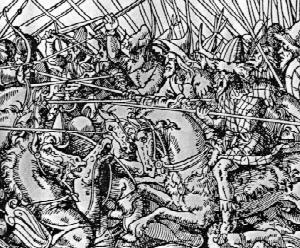
In an encounter near Greci, SkanderbegÕs soldiers routed a force of Angioini rebels under command of Count Piccinino and forced them to flee.
Skanderbeg and our ancestors rout the rebels
To show his appreciation for their victory, King Ferdinand granted SkanderbegÕs soldiers permission to stay and settle in the area where the battle had taken place. This not only rewarded the Albanese, but also gave the King a body of faithful fighting men to guard against future insurrections from Puglia to the southeast.
The soldiers chose to settle in the ancient abandoned village of Greci itself because in those days it was wooded and well watered and appeared to them to be Òlike a flower in the middle of a deep green forest.Ó [Footnote 1]
According to the oral history, twenty-two Albanese soldiers and their families settled Greci. Their names have been passed down from generation to generation for over five hundred years: Bellusci, Bina, Boscia, Cozza, Filaseta, Flamingo, Gliatta, Lauda, Lucchese, Luso, Mascia, Manes, Meola, Norcia, Panella, Pinto, Poppa, Pucci, Rex, Sasso, Sollazzo and Vara. Salza and Scrima are also mentioned. People with these earliest names still live in Greci today, after more than five centuries.
Traditional history says that after living in Greci for some time the Albanese returned to Albania, were driven out by the Ottoman Turks and returned to settle permanently in Greci. It is not certain when or whether they all went back.
Some may have tried to go back in 1480 when Gjon Castriota, SkanderbegÕs son, gathered an army of Albanese warriors in southern Italy and led an armada of four warships across the Adriatic to reclaim the Himare region of Epirus from the Turks. After some early Albanese successes, the Turks mounted a massive counter-assault and by 1492 had driven many of the Albanese to seek refuge on islands off the Albanian and Greek coasts before making their way back across the Adriatic to Italy. [Footnote 2]
In any event, it is clear from written records that the Albanese were established permanently in Greci and paying taxes in 1522.
The Albanese language and many of the old customs are still prevalent in the village today, especially among the older people, but emigration continues as people move from the village to find employment elsewhere. The population has decreased dramatically since the late 1800Õs.
[See Footnote 3] —————————————————————————————————————————————-
Footnote 1 – From a graduate thesis discussion of the History of Greci by Bartolomeo Zoccano under the auspices of the University of Naples faculty of Letters and Philosophy, with professor A. Scirocco in the academic year 1974/75.
Footnote 2 – See “THE STRADIOTTI PAPERS” by John Cusimano, on the Web and Internet, for detailed information about the history, traditions and migrations of the Arberesh populations in Italy and Sicily.
Footnote 3 – For details of Greci History see “APPUNTI DI STORIA CRONOLOGICA DI GRECI” by Sac. Gerardo Conforti, 1922.
By Dick Vara
6/22/97

